I’m generally a pretty active person. I run year-round, I’ve got a weight training program. I only eat six pounds of potato chips a week. I do what I can to keep myself in shape. But there’s a difference between doing enough to justify your next bowl of ice cream and doing enough to make it across your next (dozen) portage(s). Over the years, I’ve found that it doesn’t matter how much you try to stay fit over the offseason, nothing really prepares your body for canoe tripping, except more canoe tripping. This means building back up at the start of each season or, at the very least, not going from zero to 100 on that first trip. I forgot that last year, and the net result was a tough trip.

That first trip of 2023 was a big one. It took me down from the Kiosk access point through Maple and Erables Lakes, onto Maple Creek and then down a string of smaller lakes to meet up with the Nipissing River at the Highview Cabin. From there, it took me along the Nip to High Falls, and then back up to Kiosk by way of Nadine Lake, Osler Lake and Heart Attack Hill (and more!). This was a bucket list trip. I’ve been staring at that stretch between Maple Creek and Highview Cabin, not to mention Highview Cabin itself, on the map for years. On top of that, I’ve wanted to visit Nadine Lake since I started this thing back in 2016. And this trip let me do both.
Awesome, right?
Well, yes. But, also, there’s a reason Nadine and the Highview route stayed on the wish list for so long. They’re both kind of a pain to get to. That stretch in between Maple Creek and Highview in particular is about as remote as you can get in the Park. There’s no easy way in without a small plane and a parachute, or maybe a very powerful catapult. And, since I’m still waiting for the patent office to approve my long-range canoetapult design, my buddy Mark and I were stuck doing it the old-fashioned way: with a canoe, some paddles and, by the end, a healthy dislike of alder.

I won’t revisit the entire trip here, I’ve got about 10,000 words on that elsewhere if you’re interested. What I will say is that this is a very challenging route. The first day included a couple of big lakes, seven portages and the second gnarliest crossing of Kiosk Lake I’ve ever done. The second day took us through Maple Creek between Skuce Lake and Tillie Lake, which is the place dreams go to die (and get swarmed by alder spiders). The third day involved quite a few low maintenance portages and the fourth day was 25 KM along the Nipissing, which has never met a twist or turn it didn’t like. The fifth day was relatively easy, as long as you consider climbing literal mountains with a canoe on your back relatively easy (not literal mountains, but tell that to my legs when they were about 3/4 of the way up Heart Attack Hill). And the sixth day … well, the sixth day is when I realized that I didn’t particularly want there to be a 7th day.
So, what happened?
Simply put, this route was too much too fast. This was my first trip of the season and the first time in six months I was reintroducing my back and legs to the joys of hiking with boats. And I wasn’t ready. As it turns out, a few sets of deadlifts a week isn’t quite the same as lugging 80 lbs of gear and boat up a waterfall after paddling your first dozen km of the season. Who knew?
 My back (who is an absolute jerk at the best of times) took about two days to realize it wasn’t thrilled with the working conditions. From then on it was a steady downhill (although it felt like most of the portages were uphill) and by day six my back was firmly established in its second career as a pretzel. It didn’t help that some of the interior baffles in my sleeping pad had broken down, resulting in a bulge right where my lower back went. By the end of the trip I was in a lot of pain and not feeling particularly thrilled with whoever invented the canoe. I pulled the chute on the trip a day early, and headed home with my tail between my legs.
This didn’t have to happen! This route, while challenging, is certainly manageable as a first trip of the season. But it wasn’t manageable the way I planned it. I set it up so that we’d be expending max effort right from the start, and that leaves little margin for error (or 40 year old backs). If I’d even just split the first two days into three I think things would have been smoother down the line. Shorter days would have meant less wear and tear on the muscles, and would have allowed for more recovery time as well.
In a way, this year’s lesson is the spiritual successor to 2021’s Start Slow. Of course, back then I was bragging about how I’d finally learned my lesson and had an awesome start to the tripping season because I took it easy for the first trip of the year. This time around the theme is just slightly different.
 The good news is that I don’t think there’s going to be a 2024 version of Start Slow in next year’s Moosies. My first trip this year looks a lot like my first trip last year in terms of distance and time, but with an important difference. Last year we went 20 KM for our first day. This year, we don’t hit KM 20 until Day 3. And those first 20 KM are pretty tame. We’re going Shall Lake to Booth for Day 1 and Booth to Round Island Day 2. With any luck by the end of Day 2 my back and I will be watching the sunset on Round Island and agreeing that there’s no place we’d rather be (at which point I’ll show my back the map for days 3 and 4 and it can go right back to hating me).

My Labour Day trip was a loop out of Cedar Lake that included portions of both the Petawawa River and the Little Madawaska River. When I originally planned out the route I had us going clockwise from Cedar. So down to Radiant Lake the first night, up the Little Madawaska River to Philips Lake the second night and on to Catfish Lake for the third night before heading home along the Petawawa. My thinking with going this direction was that it would start us with a relatively easy downhill day from Cedar to Radiant. It would also save what I thought would be the toughest portage of the trip, the p2400 between Catfish and Cedar known as Unicorn Hill, for the last day. By then, our packs would be lighter and our legs would have had a couple of days to get used to portaging again. It sounds like a reasonable way to look at it, but as it turns out, it isn’t. Or, more charitably, it’s not the most complete way to look at it.
 Here’s the thing. Portages loom large in my mind. I spend more time thinking about those 500-1,000 meter boat hiking breaks than I do the 5,000-10,000 meters on the water sandwiched around them. I actually like portaging (to an extent. I’m not a masochist), but I worry about them way more than I do any other aspect of a trip. With that in mind, I initially planned that Labour Day loop to optimize the portaging and figured the time on the water would be more or less the same regardless of which direction we went. As we got closer to the trip I started to wonder about that.
My route had us going upstream on the Little Madawaska for pretty much all of Day 2. That’s about 12 KM of paddling against the current on a relatively narrow river. It also had us crossing Philips Lake and Hogan Lake, two large and exposed lakes, from the east to the west. Why does going east to west matter? Because Algonquin’s prevailing winds blow west to east, which means you’ve got a better chance of hitting a headwind going east/west than you do west/east, and neither of Hogan or Philips are lakes on which you particularly want to hit a headwind. The more I thought about it, the more I realized that maybe I needed to shrink the “PORTAGES SCARY” weighting in my trip planning software (this software is mostly playdough) and add a little bit to the “Things that might suck on the parts of the trip where you’re going to spend most of your time” section. It’s a poorly named section, but an important one!
I talked it over with the guys on the trip, who all agreed that they’d much rather start with a couple of bigger portages rather than fight a possible current for all of Day 2 and possible headwind for all of Day 3. We made the call and flipped the trip around, starting from Cedar and going counter-clockwise through Catfish, Philips and then out through Radiant (but actually Clamshell as Radiant was fully booked by then). It seemed like the right decision, but unfortunately the only way we’d ever know if it truly made things better is if we could somehow meet our parallel universe selves from that darkest timeline where we didn’t make the change.
Oh, wait, we did!


On Day 2, a couple hours after settling into our (awesome) beach site on Philips Lake, another group of exhausted looking trippers washed up on the beach. They’d come from Radiant that morning and were doing the exact route I’d originally planned. They’d been fighting both the wind and the current all day, and they looked tired. We, on the other hand, had had a mostly awesome day coming down from Catfish. There’d been a big wind on Hogan, but it was behind us, and the current on the Little Madawaska between Hogan and Philips, while barely noticeable, was certainly better to paddle with than against. We were feeling pretty great about ourselves while these guys looked like they were ready to turn their canoes into signal fires and call for an extraction (I’m exaggerating, but they did look beat).

There are a couple of things I took from this one. First, I need to balance out how I think about portaging and paddling when I’m planning. My eyes need to stop skipping from one red (or black depending on your map) line on the map to the next, more or less blinking away all the blue in between. Second, change is good! It’s never to late to rethink a trip plan. It’s worth it to look at a route with fresh eyes before you head out. Planning a trip is kind of like writing a paper (or a blog post!). Your first draft could be great, but it’s probably not going to be your best work. Take that draft, tuck it away in the drawer for a little bit, then pull it out again and see how it looks. Odds are you’ll find at least one sentence not writed well or one river that would look a whole lot better going downstream than up.

I’m a sucker for terrible horror movies. In my opinion, Evil Dead 2 is one of the greatest achievements in the history of cinema, nay, humanity. A short but certainly incomplete list of horror movies starring cabins in the woods that I have very much enjoyed includes: Evil Dead, Evil Dead 2, Evil Dead the Musical (not a movie, but certainly counts), Cabin Fever, Cabin in the Woods (the GOAT of Cabin in the Woods movies) and, of course, Tucker and Dale vs. Evil. You’d have thought, being as well aware of all the shambling horrors from beyond that typically come with your run of the mill Cabin in the Woods as I am, I’d steer clear of the Park’s Ranger Cabins. But, last summer at least, you’d be have been wrong.

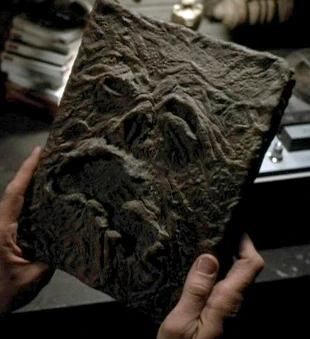
I stayed at two of the Park’s ranger cabins on my spring trip out of Kiosk: Birchcliffe Cabin and Highview Cabin. Having spent a night in each, I can confidently say that, for those two nights at least, I experienced absolutely none of the usual Cabin the Woods phenomena. There were no doorways to other dimensions, no demons haunting the woods (that I saw), no Necronomicons and nothing unspeakable buried in the basement (in fact, neither cabin had basements as far as I can tell) and absolutely no mutant mountain folk trying to eat my brains. You know what I did find? A couple of wood stoves, some bunk beds and, most importantly, roofs. You have no idea how welcome a roof and a stove are until you’re watching flurries drift across Birchcliffe Lake and wondering if you’re going to have to start including a snowbrush on your spring gear list.
Anyways, yeah, there’s not much to this lesson except to say that if you can build one of the Park’s Ranger Cabins into your route, it’s well worth checking them out. They’re a bit more expensive (starting at $62.75 and adding another $11.99 for each additional person), but they’re worth the cost, especially in the early spring or late fall.
