A lot of my time on trip is spent thinking about what’s coming next. What’s the next portage going to be like? What’s around the next corner? Where am I going to find the next bug bite (everywhere, it turns out)? It isn’t usually until the end of the day, when I’m sitting by the water watching the sunset that I take stock of the day just passed. That’s when I’ll think back to a moment here and a moment there and realize, man that was pretty cool. Those moments, the ones that come to me when the day is done, they’re not the contenders in this category. Because, as great as those moments are, it’s the ones that break through the “what’s next?” and hit me upside the head with the sledgehammer of this is awesome right here, right now! that really stand out. I had a few of those moments this year but in my mind, despite the stiff competition, there’s a clear winner.
The morning of the the fifth day of my spring trip we were going from Mallic to Dickson. This meant a lot of open water paddling on Lavielle and Dickson Lakes, two of the larger lakes in the Park. The forecast was iffy and as a result we decided to get an early start to hopefully beat the wind and rain. From experience, we knew that Lavielle in the wind was not pleasant. So we set our alarms and hit the water running, er paddling. We reached the end of the Crow River segment of our morning about an hour later. We were moving quickly, but not too quickly that we couldn’t stop for a quick side trip up to Woodcock Lake. Woodcock was fine. A small dead end lake at the end of a short, generic portage. We hiked up, I took a picture, and we came back.
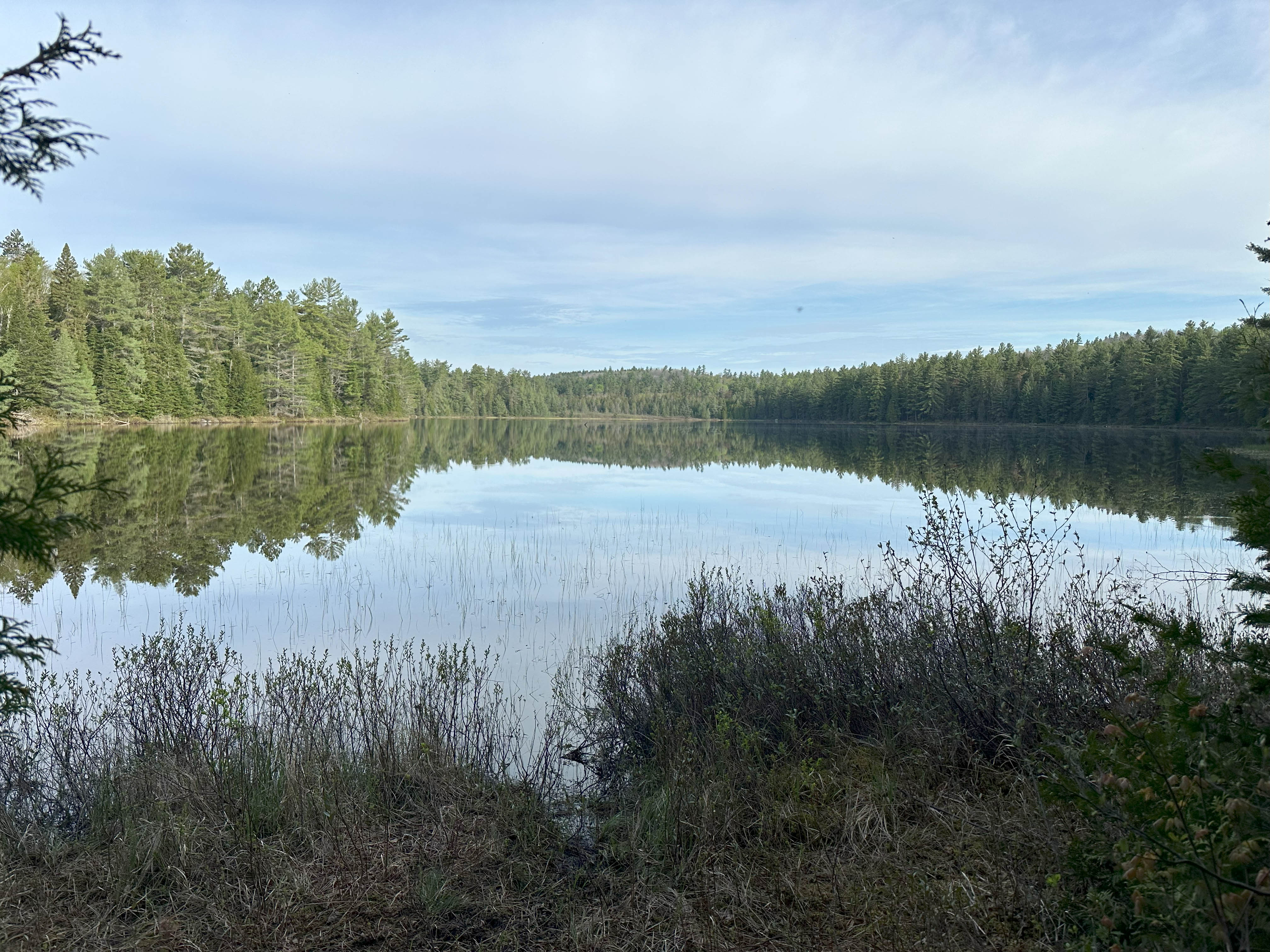
That’s not the moment.

The moment came afterwards, when we arrived back at the Lavielle/Crow end of the portage. It was a beautiful morning. Blue skies, calm water. Any weather that might be coming in was still a long ways away. Our canoe was pulled up at the portage takeout, half in half out of the water. Behind it Lavielle emptied into the Crow, not that you could tell by the mirror-still water. There was a faint wisp of campfire smoke drifting across the river from the far shore and not a sound to be heard apart from our footsteps on the portage. It was beautiful; the kind of thing you’d get if you asked an AI to take a break from conquering the world to generate a picture of a perfect canoe trip scene. I remember thinking how gorgeous a morning it was and how lucky we were to be there. That feeling stayed with me as we pushed off from the takeout and paddled towards Lavielle, the shoreline on either side of us mirrored on the water’s surface. At one point an eagle flew out of the trees and circled the river ahead of us, at another my buddy pointed at a swathe of green to our right, and its reflection below, and said it looked like a “wall of Canadiana”. At no point did I want to be anywhere except for exactly where I was at that moment.
And that’s it. That’s our (slightly elongated) moment and the winner of this year’s Best Moment Moosie.


It’s hard to definitively say what makes a good campsite. One person’s dark hole in the trees might be another person’s cozy forest hideaway. Maybe you love wide open sites for the views while someone else hates those same wide opens sites because they’re too exposed. Wherever your criteria, deciding if a campsite is good is as much an art as a science. You may not be able to perfectly define what makes a good campsite, but that doesn’t mean that you don’t know one when you see one. For me, there were two campsites that really stood out this year. Unfortunately, this category is not called Best Campsites, so I’m going to have to narrow it down. Our two contenders are White Partridge Lake, Site 1 and Booth Lake, Site 14. But what made these sites special? Let’s find out!

White Partridge, Site 1 is at the north end of the lake. It was my landing spot on Day 3 of my spring trip after one of the hardest days I’ve ever done. At that point, as long as the site wasn’t literally on fire I’d probably have been happy with it, but this site cleared that bar and more. It’s an average sized spot, maybe trending a bit towards the small side. It’s got room for a couple of tents, a nice fire pit set up and a decent amount of useable space given the relatively small footprint. The shoreline is a shelf of wide, sloping rock, which I absolutely love. The swimming is good and the views are better. From this site you’ve got a great vantage on the top half of White Partridge, and its got a killer sunset view to boot.
So, great site, great views, great swimming … we’ve got a winner, right? Well, no. Because as much as I liked that site on White Partridge, I think I liked the one on Booth just a little bit better.
 Booth Lake, Site 14 is tucked away about halfway down one of Booth’s western bays. The location is awesome. Booth is a busy lake, especially on a long weekend, which is when we were there. If you stay on one of the east shore sites you’re going to have people paddling past all day. Not Site 14. There’s no reason to go into the bay unless you’re going to the site, so staying here means you get a semi-private spot on a very public lake. But is the site worth it? Yes! To start with, it’s a big site. We had 9 people in our group with three tents and all kinds of accessories. We fit comfortably on the site and even found a great spot to hang my Opeongo A1 Aerial Tent. The site is a bit enclosed. There’s growth along most of the shoreline, but that just adds to the sense of privacy rather than making the site feel claustrophobic. There’s a great swimming area, a good kitchen set up and a decent fire pit as well. Probably my favourite part of the site is the nearby cliff. There’s a path out the back of the site that leads you up the hill and from there you’ve got a great view across Booth. Most importantly, however, the kids loved it. It’s a great site for them to roam and explore with enough room that no one is tripping over anyone else.
You know what’s funny? All things being equal, I’d probably say that the White Partridge site is the objectively nicer of the two sites. But that last point I made about the kids loving the Booth spot, that’s what tips the scales in Booth’s favour. Any site you can bring the kids and know they’ll have a good time is going to be pretty hard to beat, and this year no other site was up to the challenge. So, congratulations to Booth Lake, Site 14, this year’s Best Campsite winner!


Like Best Campsite, this year’s Best Lake category is a two horse race. And, like Best Campsite, one of those horses is White Partridge Lake. The other horse is Godda Lake. Godda is a lot smaller that White Partridge (think, the Li’l Sebastian of lakes) and, on the surface, wouldn’t seem like much of a contender. But, while it might be small, it’s got an ineffable charm that you have to see to believe. Or read about! Like we’re about to do right now!

Godda is a mid-sized lake located just west of Booth Lake. It’s the biggest in a series of smaller lakes that loop off of Booth and it takes a bit of work to get there. The portages along this stretch are all lower maintenance and the two that lead into Godda in particular could be challenging in the wrong conditions. But once you’re there, it’s worth the effort.
When you arrive on Godda, regardless of which direction you’re coming from, you’re greeted with a view of the far shoreline that is quintessentially Algonquin. The surrounding forest is a mix of hard and softwood and the water is clear(ish). There are two sites on Godda, located at about the mid point of the lake across from each other on the east and west shores. Both sites are pretty decent. They’re relatively big, with room for at least a mid sized group. Of the two, Site 2 is my favourite. It sits on a small point on the west shore. It’s got a big footprint, with room for three tents (at least). It’s got a great view of Godda, a nice fire pit setup and, crucially, is surrounded by sandy shallows that are perfect for kids to play in. Site 1 is fine, but it’s a bit enclosed and closer to a swampy area than I’d normally want.

So far, I feel like I’m describing a pretty generic Algonquin lake, and maybe that’s true. But I still think Godda deserves to be in the conversation based on location alone. See, this part of the Park is typically quite busy. Booth Lake is one of the more popular spots in that neck of the woods and getting a permit there can be challenging at peak times. Godda is another hour to an hour and a half’s worth of work away from Booth, but it feels like it’s at the other end of the Park. It’s quiet, pretty and private. The only people going up to Godda are the people who are camping there, and with only two campsites it means that it’s never going to feel crowded. It’s hard enough to get to that it’s not an automatic alternative if Booth is full, but still manageable if you don’t mind a bit of extra carrying.
So, private, pretty, good campsites and not too far from an access point? Godda seems like a strong contender, right? Right. But, you know what, so is our other nominee. In fact, let’s talk about White Partridge Lake right now.
If Godda Lake takes a bit of extra work to get to, White Partridge Lake takes all the extra work, plus some more. There is no easy way to get into White Partridge (by canoe, but we’ll get to that caveat in a minute). Coming from the east you’ve got a low maintenance route out of Achray that includes multiple KM+ (and in one case 4KM+) portages. Coming from the north you’re fighting the current and alder on White Partridge Creek for 13 KM. Coming from the west, which is probably the easiest route in, you’ve got one of the most miserable portages I’ve ever done in the Little Dickson to Sundassa carry, along with about 25 KM of paddling and portaging. In other words, White Partridge makes you work for it.
But it’s worth the work!

White Partridge is a big lake. Not Opeongo or Lavielle big, but still somewhere in the neighbourhood of five and a half square kilometers in area with about 13 kilometers of shoreline. Around those 13 kilometers you’ve got six backcountry campsites, which is a pretty decent ratio of campsites to kilometers. If you make it to White Partridge Lake in one piece, odds are it’s going to feel like you’ve got the whole place to yourself. And what a place! White Partridge was beautiful. Like Godda, the surrounding forest was a mix of hard and softwood. Unlike Godda I remember there being some variation in the shoreline aesthetic. While most of the shoreline is what I’d call generic Algonquin, towards the northwest the trees thin out and there are some open slopes up from the water. And, just to the east of those slopes, you’ve got an open grassy area that makes White Partridge unique in Algonquin.
Unique, you say? How so?

See, that open grassy area is why a couple of paragraphs ago I added the qualifier “by canoe” when I mentioned that White Partridge is hard to get to. Because canoe isn’t the only way you can get to this seemingly deep in the backcountry lake. It turns out that White Partridge Lake is home to Algonquin’s only Horse Packing campsite. There’s a road leading into White Partridge that can be used to ride (horses) into the site. The road is wide enough that a horse can pull a trailer behind it and is also wide enough, apparently, for a pickup truck towing a tin boat. Weird, right? You wake up in the morning feeling like you’re a million miles from anything, look across the lake and watch as a couple of trucks pull in and start backing a boat into the water.
That oddness aside, White Partridge is an awesome lake! Despite the world’s most rustic parking lot on the north shore, it’s still a beautiful spot. The view from Site 1 is awesome, and I like the fact that it’s got that horse packing site, unexpected pickup tuck sightings aside. In fact, I like it so much I don’t think we have to look any further for a winner. As much as I enjoyed Godda, White Partridge is bigger, prettier and has at least one better site than either of the Godda options. Also, it’s horse friendly! So congrats to White Partridge Lake, this year’s Best Lake Moosie winner!


