Trip Reports, Campsite Reviews & More

Trip Reports, Campsite Reviews & More

How Are The Bugs?

Surviving Bug Season in algonquin park

Algonquin Park is home to animals of all kinds. From the majestic moose to the industrious beaver to the occasional bachelor party ripping it up on Burnt Island Lake, there’s wildlife all over the Park. You know what else lives there? Bugs. Lots of them. Algonquin Park is home to over 7,000 species of insects and there is a small but determined subset of those 7,000 species who very much want to have you for dinner. One of the most frequent questions I get is “how are the bugs in Algonquin?” While I can’t speak for their emotional state, I can tell you that, physically, the bugs are doing just fine. Bug season in Algonquin begins around mid-May (but sometimes earlier!) and starts to peter out by early August (but never really seems to end completely. I’ve had a mosquito buzzing me on Thanksgiving). Over the course of the spring and summer the Park sees multiple waves of biting insects. The most common of these are the black fly, the mosquito. the horse fly, the deer fly and the stable fly.

Hi there! Thanks for reading! Hope you enjoy and feel free to subscribe if you do! A quick note for anyone receiving this through an email subscription. First of all, thank you for subscribing. Secondly, this post looks better when viewed through the website. This link will take you there: How Are The Bugs In Algonquin Park? (And, if you don’t already subscribe, there’s a subscription sign up at the bottom of this report!)

Black Flies & Mosquitoes

Researchers once trapped one million blackflies rising from one square meter of the Little Oxtongue River

The first to emerge are the black flies. Black flies hatch from flowing water and start to swarm in mid-May. They love to go for the face and neck and the area behind your ears. Anywhere the blood flow is close to the surface of the skin. They are usually out in full force by the May long weekend. This is, of course, dependent on the weather in any given year. If the spring is long and cold, bug season might be pushed back a bit. If ice out comes early, you might see blackflies in April. No matter when they come, you know that once you see your first black fly their mosquito buddies won’t be too far behind.

Mosquitoes are probably the best-known flying blood suckers this side of Dracula. They hatch from standing water in mid to late May, are at their most potent in June and early July, and slowly die off through the rest of the summer. I’ve never been able to decide which is worse, the black fly or the mosquito. Black fly bites can be brutally itchy while the whine of a single mosquito buzzing around the top of your tent will slowly drive you insane. We’ll call it a tie.

Both black flies and mosquitoes are romantics at heart. They love sunrises and sunsets and are at their most active around dusk or dawn. That doesn’t mean they can’t get you at other times during the day, but sunrise and sunset can be particularly difficult.

Horse Flies, Deer Flies & Stable Flies

Horse flies, deer flies and stable flies are later summer arrivals. They tend to show up in numbers towards the end of June and stick around through the rest of the season. Deer flies and horse flies in particular can take a chunk out of you. Stable flies are a bit smaller and tend to focus on your ankles and legs. Either way, if one of these flies decides to take a bite it can be painful.

Unlike black flies and mosquitoes, deer flies, horse flies and stable flies are active throughout the day. I’ve found them to be particularly treacherous mid portage. There’s nothing quite like the waking (walking?) nightmare that is trudging through the woods with the sun beating down through the canopy, sweat dripping off your nose and a determined cloud of deer flies competing to see which one can bite you hard enough to make you drop the canoe.

Between Three Mile Lake and Upper Kawa, the location of the worst deer fly attack of my life
... Until this one, one portage later between Upper Kawa and Kawa

Fighting Back

So, if the Park is effectively ground zero for the Bugocalypse between Mid May and Mid August, what’s a canoe tripper to do? Mid May to Mid August is prime paddling time. The days are long, the water is warm and the weather is great. As much as I enjoy the ice out and fall tripping seasons, I don’t want to give up on the time in between.

After the Bugocalypse

I’ll tell you what you shouldn’t do. Nothing. I tried this for one June trip and came out looking like my chicken pox had caught chicken pox. That was my first trip in peak bug season and it nearly became my last. For a canoe trip in northern Algonquin over the first weekend in June I brought shorts, a t-shirt, a baseball hat and not much else. I might as well have been wearing a dinner bell for the blackflies and mosquitoes.  I spent one miserable night alternating between walking quickly around my campsite while waving my arms around my head*, and standing chin deep in the water on Mouse Lake. I called it quits the next morning and probably singlehandedly got the makers of Afterbite through their Q3 earnings season.

Okay. So doing nothing is a bad plan. What’s a good plan?

Glad you asked.

After the disaster on Mouse Lake I spent a lot of time (and a decent amount of money) figuring out how to, if not bug proof, bug optimize my spring and early summer trip plan. I’ve accumulated a few pieces of gear that I’d now consider essential for any spring trip, and I upgraded my clothing list from wildly inappropriate to armored beekeeper. Between these two changes, and a better plan for where and where not to pitch my tent for the night, bug season trips have become completely manageable, if not downright enjoyable. Here’s what I did:

Bring Proper Clothing

This should be a no brainer, but apparently it wasn’t (for me). If you’re camping in bug season you want to add a lightweight long-sleeved shirt and pair of pants to your packing list. Maybe even two if you want something you can wear while you’re on the move during the day and something that won’t still be a sweat soaked second skin at night. There is some evidence that black flies and mosquitoes both like to express their inner goth and are attracted to dark clothing. Lighter colours may make you slightly less appealing.

Ready for the bugs on Little Mink

Bring Bug Protective Clothing

This is in addition to the long-sleeved shirt and pants I mentioned above. If your spring trip checklist doesn’t include a bug jacket or shirt, you need to redraft that checklist. So, what is a bug shirt? Essentially it’s a long-sleeved jacket or shirt that incorporates a mesh hood and face covering, meaning you are protected from your waist up from all manner of flying bitey things. There are plenty of different brands out there to choose from. My personal favourite is The Original Bug Shirt. The Original Bug Shirt is a lightweight shirt that incorporates a zippered hood, a mesh face covering and mesh side panels into the design. The mesh sides provide breathability while the rest of the jacket consists of a light coloured polyester. I really like this design. It’s both comfortable and durable. I’ve owned bug jackets that are entirely mesh. While this might seem like it will be more breathable, it also makes the shirt much more delicate. My all-mesh Canadian Tire special lasted exactly one trip down White Partridge Creek before the alder ripped it to shreds. My buddy was wearing an Original Bug Shirt throughout the same trip, and it stood up nicely to everything the alder threw at it.

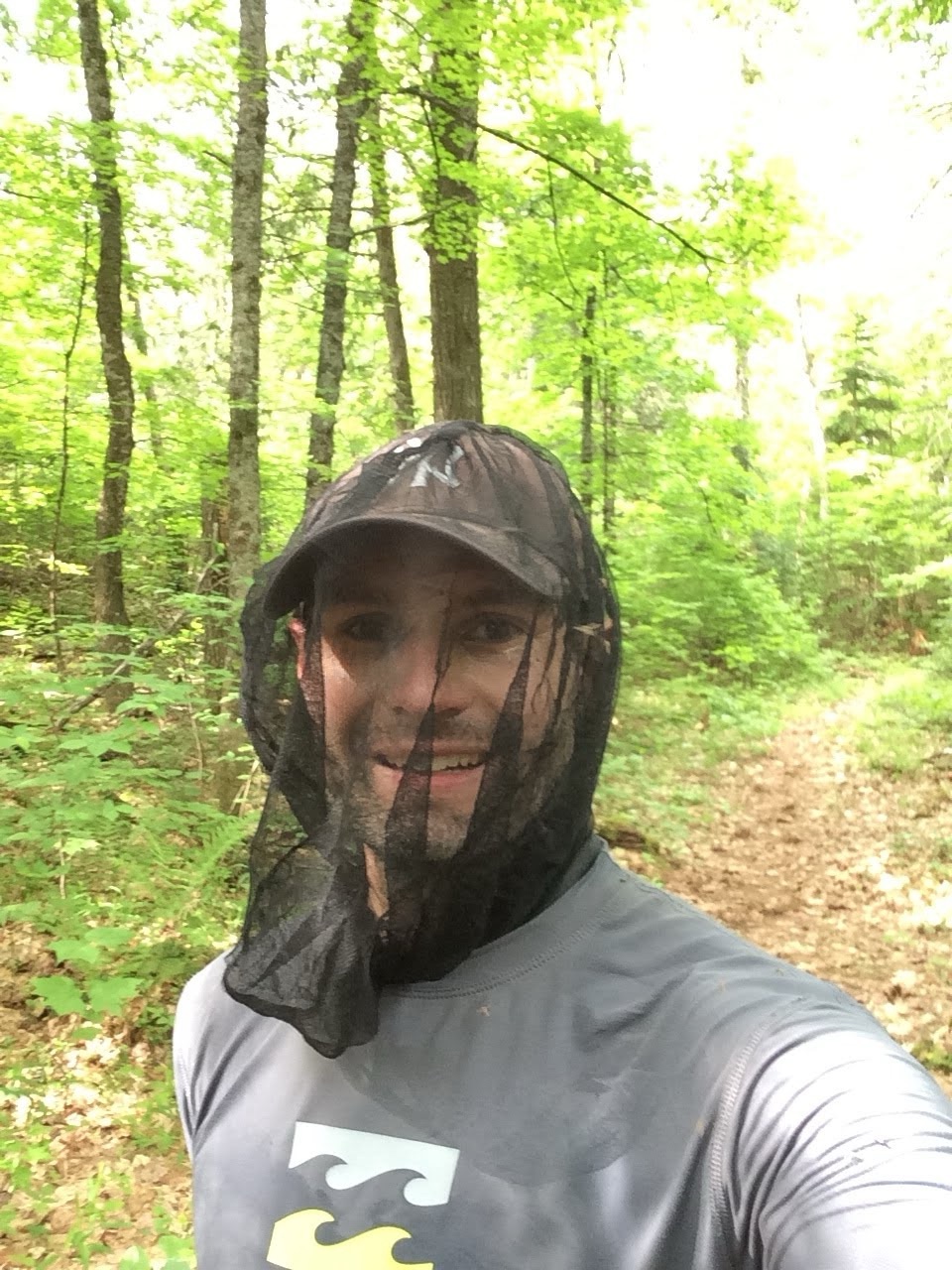
A quick note on head nets. Don’t. That’s the note. Just don’t. (Okay, maybe I should back up my negativity. In case you’re not familiar, head nets are exactly what they sound like. It’s a small net you wear over your head that ends around the base of your neck. I tried a head net once. Basically, it just became a bug trap. I actually think I would have come out of the experience with fewer bites if I hadn’t had the mesh getting in the way of me smacking all the bugs that got under the net no matter what I tried to do to cinch it tight). 


The folks at The Original Bug Shirt don’t want you to end up looking like me! They’ve offered me a 15% discount code on any of their bug protective products. The code is AABUG15 and their website is here: The Original Bug Shirt.

Pack a Bug Shelter

This one was a game changer. There are quite a few but tent options out there. These are tents that are mostly mesh or netting that you bring in addition to your regular tent. The best description I’ve heard of them is “cube of sanity” and that sums it up really well. They give you a bug-free (ish) place to escape to that isn’t your tent. You have no idea how valuable that is until it’s 7 pm, the bugs have already chased you into your three-man and you’re realizing you’re going to be spending the next 12 hours getting very cozy with your trip partner. 

My favourite bug shelter, by far, is the Eureka Nobugzone. This thing is a revelation. It combines sturdy mesh walls with a pretty robust tarp up top. This means you can hide from both the bugs and the elements using the same additional piece of gear. That’s a fantastic double whammy if you’re counting pack ounces. I’ve spent many a buggy or rainy (and occasionally both) night hiding inside the Nobugzone and feeling pretty good about it.

There is, however, one major problem with the Nobugzone. They don’t make them anymore. In fact, they don’t make either of the bug shelters I’ve had experience with (The Onsight Big Bug Box shelter was a decent, entirely mesh option. Good for bugs. Useless in rain). If I were trying to find a bug shelter option today I’d either be looking for a secondhand Nobugzone or maybe considering a multi piece mosquito net set up with a separate tarp. The MSR Thru Hiker  might scratch that itch (heh). It’s an ultralight mesh tent that would give you a bit of relief. Sea to Summit is another brand I’ve always been impressed with and they have a pyramid bug net that would give you a bit more bug free space (but just a bit).

NoBugZone on White Partridge Lake
Big Bug Box on Basin Lake

Say Hello to the Thermacell

Let me be clear, your bug jacket and bug shelter are your first and best lines of defense from the flying hordes. They are going to be the difference between an unforgettable spring trip and an unforgettable no matter how hard you try spring trip. But there are things you can do to stack the odds even further in your favour, and one of the best of those odds stackers I’ve found is the Thermacell.

Prime Thermacell Spot

Think of a Thermacell as hi-tech Pic. What’s Pic? You know, that green coil you’d burn in your cabin/tent that smelled vaguely carcinogenic before you even knew what carcinogenic meant? It was designed to kill bugs with its smoke and, who knows? Maybe it did. At the very least the fumes helped you pass out along with the mosquitoes. The Thermacell takes this idea and brings it into the 21st century. For the past few years I’ve been carrying the Thermacell Adventure MR300. This is a small device about the size of a tricorder (or maybe a hairbrush for all the non-trekkies out there). It works by heating a small element on which rests a repellent soaked mat. The device is meant to create a small bug free zone and I’ve found it to be relatively effective. Unlike Pic there is little to no smell with the Thermacell, which is a nice bonus. Like Pic, wind will make a significant difference to the Thermacell’s effectiveness. If there’s a breeze moving through your site the protective zone is going to be less reliable. On the other hand, on calm nights, which is when the bugs are usually swarming, it can work pretty well. What I typically do is set up the Thermacell near the fire pit, which gives me a third (hopefully) bug free (or bug reduced) area to use.

One thing to consider when you’re looking at the Thermacell: like Pic, this thing is putting chemicals into the air you’re breathing. The active ingredients are Allethrin or Metofluthrin, which are words I just learned today and are classified as mildly toxic. You would only use the Thermacell in an outdoors and well-ventilated setting.  And you probably want to keep it away from your food. Those chemicals are going to settle somewhere, and you don’t want that somewhere to be in your bowl of rehydrated chili.

Bug Spray

This is one of the oldest lines of bug defense out there. I’m guessing pretty much everyone reading this has accidentally gotten some Off! into their eyes or mouth at some point. The good news is that bug spray is about as effective as it is awful tasting. (also, you’re really not supposed to get it in your eyes or mouth. If you do make sure to flush out your eyes and rinse out your mouth and be aware of any lingering effects).

The active ingredient in bug spray is Deet. Deet works by blocking the scent receptors of many biting insects (and ticks too), making the wearer more or less invisible to the affected bugs. The minimum concentration you’d want to see in your bug spray is 10%, and the maximum Health Canada recommended concentration is 30%. One thing to note, a higher concentration of Deet doesn’t mean it’s more effective, just that it will last longer.

Choose the Right Campsite

Bug season campsite selection is all about location. A point or island site with good air flow is ideal anytime, but particularly during bug season. While your Thermacell might not work so well when there’s a strong breeze blowing through the site, if there’s a strong breeze blowing through you won’t need the Thermacell. And I’d much prefer a non-chemical bug dispersal option if possible.

The sites I’ve found the worst for bugs have generally also had similar characteristics. They’re usually enclosed, without much air flow. If the woods around the site are particularly damp, maybe there’s a standing puddle or even a pseudo-marsh nearby, then there’s likely to be a ton of mosquito activity. If there’s some running water nearby, maybe a small creek coming out of the woods, then the blackflies can be swarming. God help you if you’re got both.

The other big red flag I’ve seen is grass. Every time I’ve stayed on a grassy site I’ve regretted it (last May’s spring trip site on Hogan being a notable exception thanks to an industrial strength wind that was blowing through for most of the day). Mosquitoes like grass because it provides shade and a place to rest during the heat of the day. There’s a site on Joe Lake’s east shore that has a pretty healthy grassy patch and an absolutely thriving mosquito population living there. I stopped there one morning for a quick break and was about ten steps away from my canoe when the swarm descended. That ended up being a very quick break.

An example of a decent point site - good air flow and no marshy spots nearby
And a not great example - Mosquitoes Ho!

Ticks

You know who else likes grass? Ticks. We haven’t talked about ticks yet in this post, but they’re a growing problem across Ontario and they are encroaching on Algonquin. They are also the most concerning of the various things that can latch onto you when you’re out there. Ticks carry a host of unpleasant diseases, including Lyme Disease and the Powassan Virus. You don’t want either of those. If you find a tick you want to get it out of you quickly and safely. Ticks dig their mouths into your skin and I can tell you from experience that they are tough to dislodge once they’re in there.  What you don’t want to do is break the tick while you’re pulling it out. That can cause infection on top of everything else. Long pants, socks over your cuffs and avoiding rolling around in grassy areas or piles of dead leaves can go a long way to keeping the ticks out. It’s also a good idea to carry a tick key or tick tweezers if one does get ahold of you. To remove a tick you need to use your tick key or tweezers to grasp the tick as close to your skin as possible. Pull upwards with a steady pressure. Don’t yank on it, twist or squeeze. This can cause the tick to release bacteria directly into your bloodstream, which is not ideal.

So, How are the Bugs in Algonquin?

They’re there. And you’ll be fine. Bug season in Algonquin is no joke, but it’s not a trip killer if you’re ready for it. The right clothing, the right gear and knowing what kind of campsites and terrains to favour or avoid will go a long way towards ensuring your spring trip is a good one. Bring a bug jacket. Bring a mosquito net or bug tent if you can find one. Consider a Thermacell or Pic for additional protection and think carefully about how close you want to be to that creek burbling behind your site. And just remember, if you decide to wait out the bugs you’re also giving up a couple of months of prime paddling time. And then you might be missing out on sights like this one.

Sunset on Hogan

Man, that’s pretty. I feel like that’s worth a couple of mosquito bites, don’t you?

Thank you for reading! Hope you enjoyed it and picked up a few tips for surviving the Bugocalypse in Algonquin Park. For more Algonquin content, subscribe below. You’ll receive trip reports, the annual Moosie Awards and the occasional Algonquin related post like this one.

** It turns out that this was a terrible way to ward off the mosquitoes. Mosquitoes are drawn to to the CO2 your body gives off. Moving around means you’re generating more CO2. Basically, treat mosquitoes like the T-Rex in Jurassic Park. If you don’t move, they can’t see you (until they can). Click here to go back to the paragraph you were just reading.

Share this:

Like this:

Like Loading...

Discover more from All of Algonquin

Subscribe now to keep reading and get access to the full archive.

Continue reading

search previous next tag category expand menu location phone mail time cart zoom edit close